The right tools for better care.
Quality improvement isn't about using every tool. It's about choosing the right approach to understand a problem, test change and learn what works.
Start with SAM's original practical guides, choose a project kit suited to your experience, explore 25 QI methods and use the Diagram Studio to turn ideas into shareable visuals.
Start with SAM's practical guides
Two original SAM publications to help you learn and apply the Five Steps to Better Care. Read them here on the website, or download the unchanged PDFs for offline use.
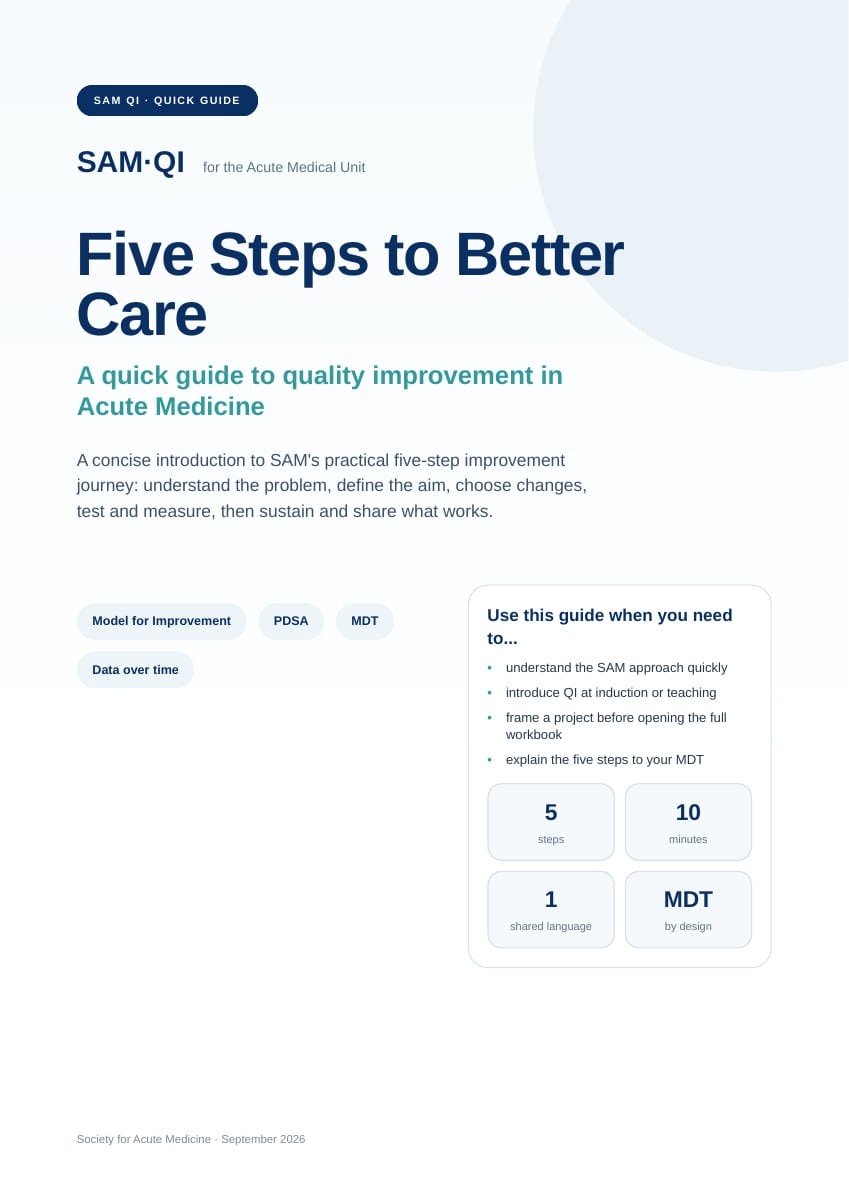
Five Steps Quick Guide
An accessible introduction to understanding a problem, setting an aim, testing changes and sustaining what works. Ideal for getting started or refreshing your knowledge.
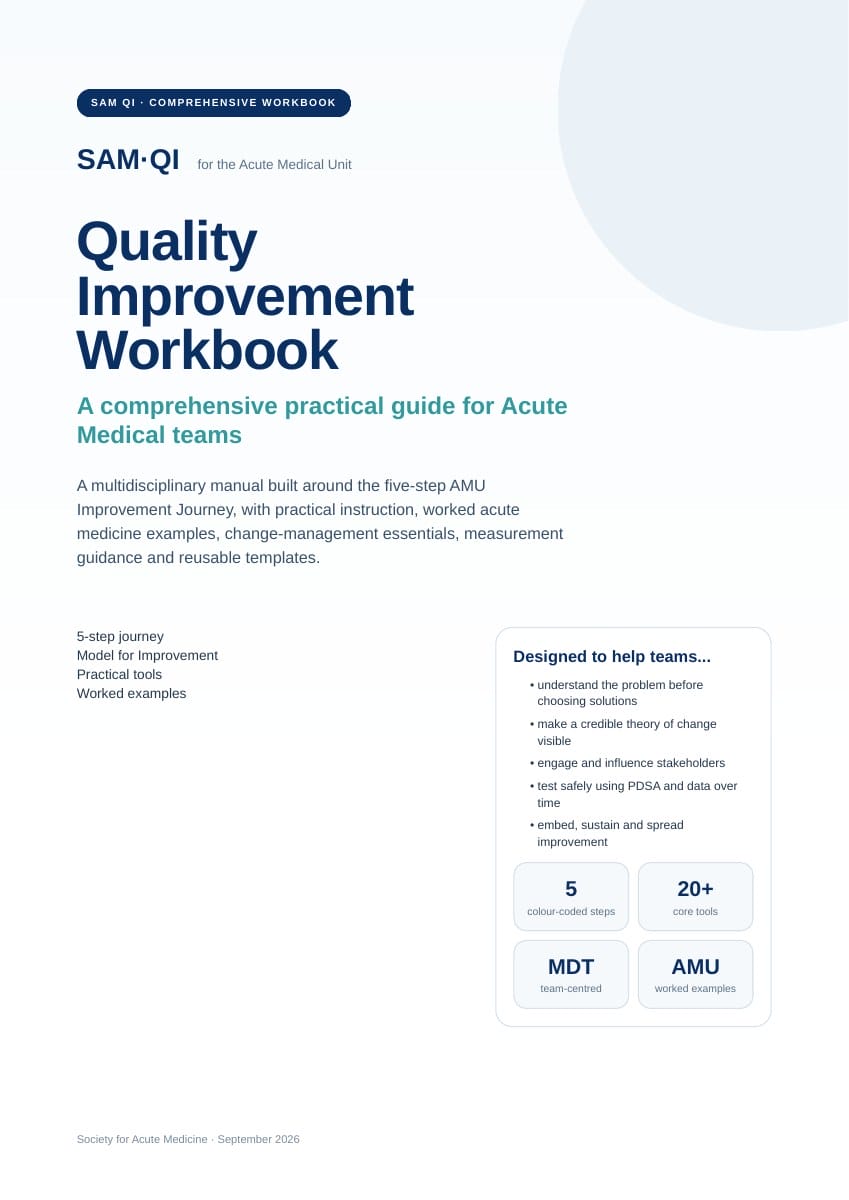
Comprehensive QI Workbook
More detailed methods, worked acute medicine examples, measurement guidance and reusable templates. Use it when you need additional depth for your project.
Read SAM's QI guides online
Read the original documents here, with page navigation, contents and search. Choose the shorter guide or explore the full Workbook; download the PDFs whenever you need them.
The reader displays the original SAM PDFs without changing their layout, images or printed page numbers. Searches and navigation happen in your browser; no project or patient information is collected.
What are you trying to improve?
Start with your problem, not a favourite technique. Choose a challenge and we'll suggest methods worth exploring.
Suggested methods
Four progressive QI project kits
Choose a level that matches the scale of your work. Each reveals a focused selection from the same 25-method library. You can view every method at any time.
The selections are SAM-recommended learning sets, using AIMQA's cumulative 10/16/23/25 progression; they are not restrictions on clinical practice or a verbatim copy of each original kit.
Explore the 25 QI methods
Search by technique or acute medicine challenge, or filter by the five improvement stages. Open a card for an example, the key question and a practical output.
Showing all 25 methods.
No methods match. Try a different term, stage or kit.
Use these as learning aids. Seek local clinical governance, patient involvement and measurement expertise as appropriate. The initial QI technique may change as you learn more about the problem.
Practise before you start
These browser-only exercises help you draft an aim or explore possible causes. No content is transmitted to SAM or saved by this page. Do not enter identifiable patient or confidential information.
Draft a SMART aim
Identify the measure, population, baseline, target and deadline.
Explore Five Whys
Each answer is a possible cause to verify, not necessarily a proven root cause.
Find the right QI tool
Choose what you need for the task in front of you — a planning template, a worksheet for testing change, or a resource to help share your learning.
SAM QI Project Log
Keep project actions, decisions, tests and measures together.
Open resourceSMART Aim Statement Builder
Turn an improvement idea into a specific, measurable aim.
Open resourcePDSA Cycle Worksheet
Plan, run, study and record a small test of change.
Open resourceSQUIRE 2.0 Presentation Template
Structure a presentation of your QI project and learning.
Open resourceSQUIRE 2.0 Reporting Guide
Understand how to report improvement work clearly.
Open resourceSAM QI Roadmap
Teaching slides introducing SAM’s five-step improvement journey.
Open resourceNo tools match your search. Try another term or category.
Learn together
Bring quality improvement to life with a practical team exercise, and learn how different perspectives help create better care.
Build a Robot
Experience quality improvement through a facilitated team challenge. Build against the clock, test one change at a time and see what your results reveal through the interactive run chart.
30–45 minutes · Teams of 4–6 · Facilitator-led

Multidisciplinary QI
Better improvement comes from involving the people who deliver and experience care. Learn how different professional perspectives, together with those of patients and carers, can shape meaningful change.
QI, audit, service evaluation or research?
These approaches can overlap but have different purposes and governance considerations. Choose the description closest to your project for initial guidance. This is educational support, not a formal classification or approval.
Check local registration, ethics, clinical safety and information-governance requirements before beginning. Seek specialist advice for non-routine interventions, randomisation, additional risk, consent questions or use of identifiable information. Arrangements vary across the four UK nations.
Trusted QI guidance, in one place.
Explore established national and international quality improvement organisations. Find structured training, practical methods, measurement guidance, governance advice and opportunities to share your learning.
SAM provides the acute medicine context. These resources help you go further, whether you are starting your first QI project or leading improvement across a hospital.
Showing all 20 resources
Learn QI and develop your skills
National learning programmes, improvement education and professional development.
Use QI methods and practical tools
Established toolkits, templates and practical improvement guidance.
Measure improvement and variation
Run charts, statistical process control and interpreting data over time.
Governance, ethics and project classification
Guidance for QI, clinical audit, service evaluation and research.
Report, publish and spread learning
Reporting standards, published improvement work and peer networks.
No resources match your search. Try another term or select All resources.
Keep improving. Share what works.
Start small, learn through measurement and keep sharing your results — including what did not work. Use the wider SAM QI Hub to support your next step and discover how others are improving acute medical care.