
Turn ideas into improvement
You've identified something that could work better in acute medicine. Now turn that concern into a clear aim, work with the people involved, test changes and understand whether care is genuinely improving.
Follow SAM's Five Steps to Better Care, with practical actions, real-world considerations and tools for every stage of your project.

Before you begin
Good improvement starts before the first test of change. A few early conversations can save time, build support and help avoid unintended consequences.
Find the real problem
Start with what patients and staff experience. Review available evidence and resist choosing a solution before understanding what needs to change.
Involve the right people
Include colleagues who understand and deliver the pathway, and those who experience the care. Agree who will lead, contribute and provide support.
Agree scope and support
Be clear about what the team can influence, the resources needed and when to involve clinical, operational or senior leadership.
Check local governance
Follow your organisation's requirements for QI registration, approval, clinical safety, data handling and consideration of research or ethics review where appropriate.
Choose the right approach for your project
Not every improvement project needs the same level of planning, support or coordination. Choose the approach that best describes your current work. You can adapt it as the project develops.
My first QI project
Choose a problem that matters and is manageable within your setting. Learn the improvement method through a small test, with support from colleagues. A useful first project does not need to be large.
Your first three actions
- Find a problem you can observe and influence.
- Establish a baseline, agree your aim and discuss the project with a supervisor or QI colleague.
- Plan a small PDSA test, record the results and decide what to try next.
Start small, but start safely
Every approach needs proportionate clinical oversight, clear responsibilities and appropriate local governance. If you are unsure whether work is quality improvement, clinical audit, service evaluation or research, seek advice through your organisation's usual governance or research processes.
Use approved systems for handling patient information. The examples and interactive learning tools on this website do not collect or store patient-level data.
Find a QI project idea
Not sure where to begin? Explore practical improvement opportunities across acute medical services. Select an idea to see a suggested aim, useful measures and a manageable first test of change.
Project ideas
14 ideasLoading project ideas...
Select a project idea
Choose a project from the list to explore how it might work.
Suggested improvement aim
What could you measure?
Try this as your first PDSA cycle
Check the latest applicable national, four-nation and local clinical guidance before deciding your measures, intervention or improvement target.
Explore relevant guidance ↗Your project, step by step
Follow SAM's Five Steps to Better Care. Choose a stage to see what to do, what your team should produce and which improvement methods may help.
Understand the problem
Understand how care currently works, who is affected and why change may be needed.
What to do in practice
- Listen to patients and colleagues.
- Observe the current process.
- Gather baseline evidence.
- Explore possible causes.
A clearly described improvement problem, supported by initial evidence and shared understanding.
Practical methods for this step
Explore the approaches most useful at this stage. Each guide explains how to apply the method and mistakes worth avoiding.
Process mapping
Make the current sequence of work visible before deciding how to change it.
Improvement is iterative. Teams may need to revisit earlier stages as they learn more about the problem and the effects of their changes.
Test a change. Learn from it.
A good improvement idea needs to be tested in practice. Plan–Do–Study–Act cycles help teams make a prediction, test a change on a manageable scale, study what happens and decide what to do next.
The learning from one test should shape the next. Explore how a team might refine an AMU handover improvement over three successive cycles.
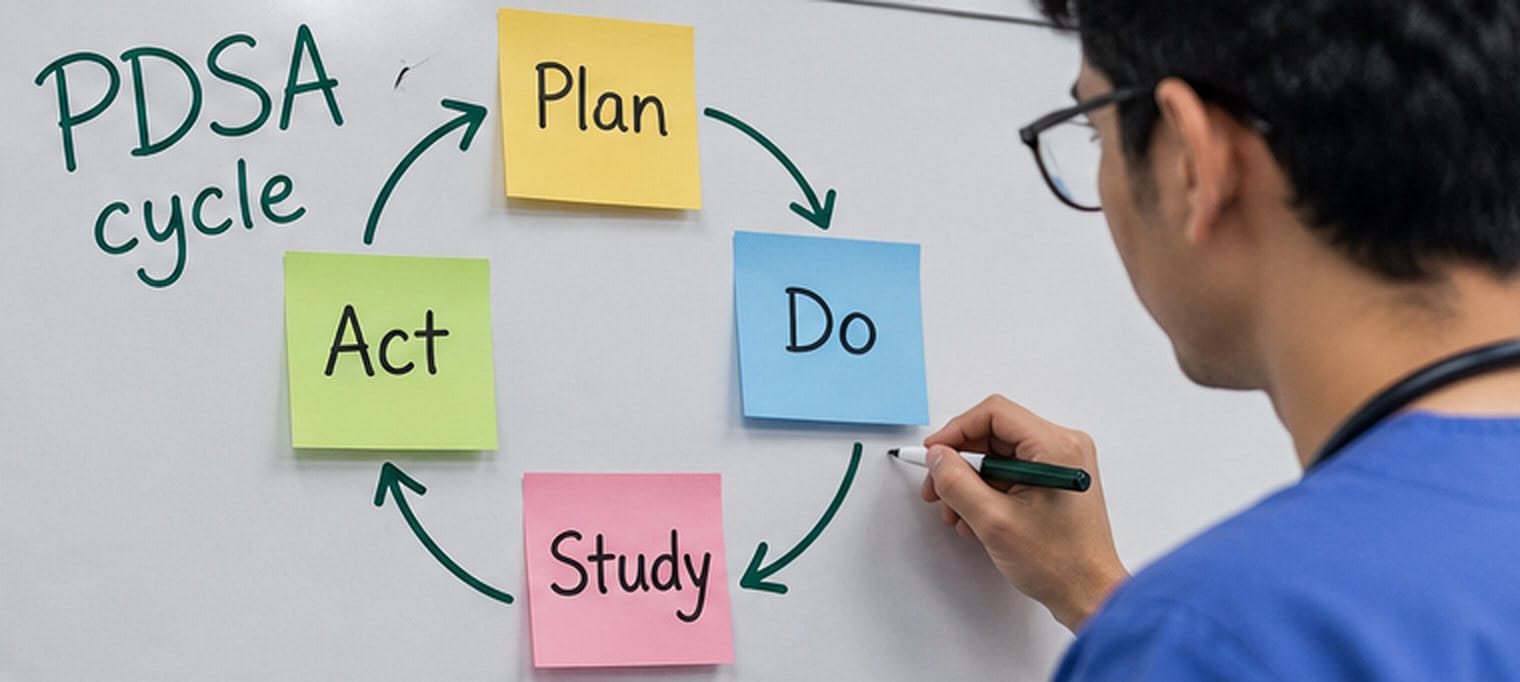
One change. Several tests. Better learning.
Choose a test, then move through Plan, Do, Study and Act. This example illustrates how small tests can build on one another before broader implementation.
Plan — make a prediction
Decide exactly what you will change, who will test it, when and where. Predict what you expect to happen and agree how you will measure it.
The proposed change, your prediction, the measures and the agreed test plan.
Cycle 1: initial handover prompt
The team proposes a short verbal prompt for one evening handover. It predicts fewer omissions of agreed critical information, without an excessive increase in handover duration.
What would we expect to see if the proposed change helps?
Measure what matters
How will you know whether a change has made care better? Improvement measurement looks beyond a single before-and-after comparison to understand what happens over time.
Select a measurement type to explore an illustrative AMU handover dataset. See how outcome, process and balancing measures answer different questions.
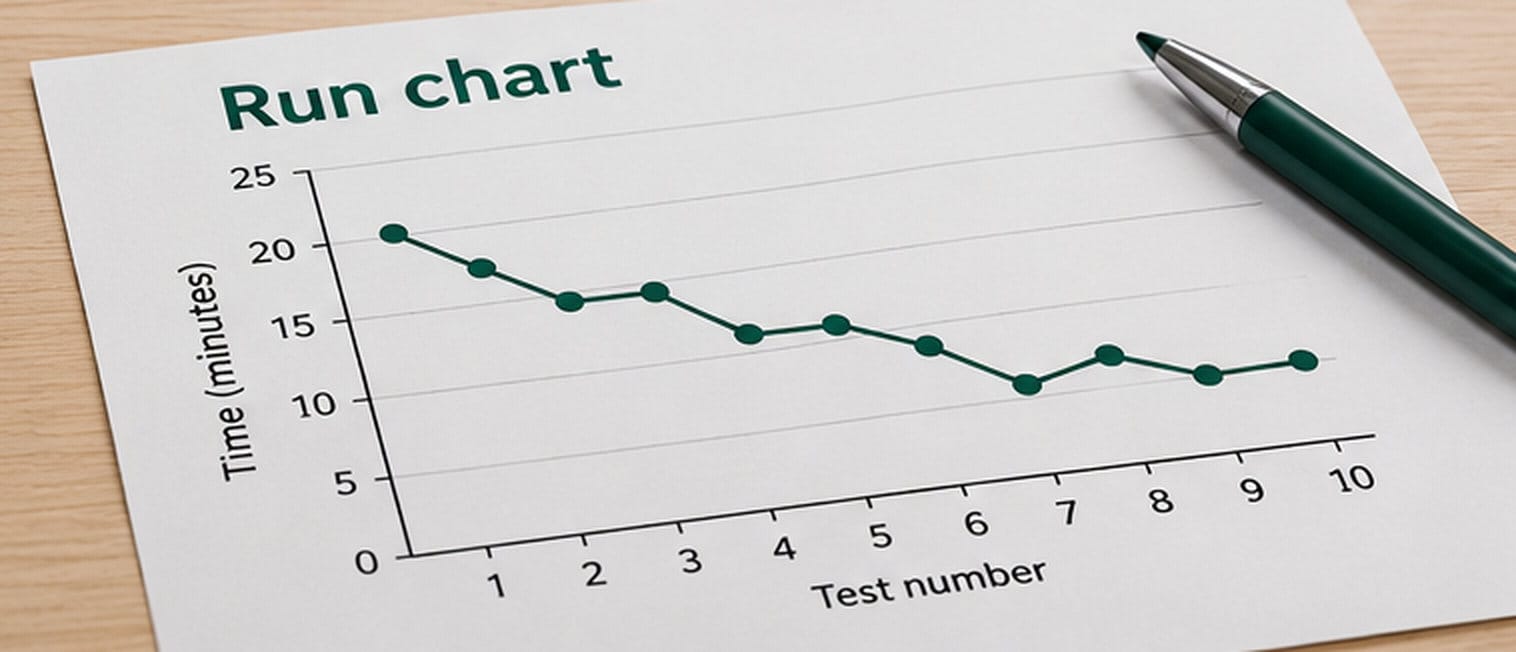
Three questions. Three types of measure.
Select each type to change the example chart and explore what that measure tells your improvement team.
Complete AMU handovers (%)
Twelve fictional observations, with an illustrative period of change beginning after observation six.
View the twelve example data points
| Observation | Period | Value |
|---|
What does this outcome tell us?
This example illustrates how the proportion of handovers containing agreed critical information might be tracked over time.
Number of sampled handovers containing all agreed critical information, divided by the total number assessed.
A favourable pattern is worth investigating, but it does not by itself establish that the intervention caused improvement.
Define before collecting
Specify exactly what counts, who is eligible, the data source, any denominator and the collection frequency. Consistent definitions make comparisons more meaningful.
Study variation over time
Plot observations in time order and annotate important changes. Use recognised run-chart or statistical process-control methods where appropriate. Do not claim improvement from one favourable data point.
Understand the wider impact
Interpret numbers alongside patient experience, staff feedback, implementation and the clinical context. A faster process is not necessarily a safer or better one.
Make improvement last
A successful test is only the beginning. Plan how good changes will become routine, continue to measure what matters and share learning so other teams can benefit.
Sustain the change
Agree who owns the improved process, how new colleagues will learn it and how performance will continue to be reviewed after the project ends.
Spread with care
What works in one AMU or SDEC service may need adapting elsewhere. Involve the new team, understand differences in context and test before scaling up.
Report the learning
Describe the problem, context, methods, measures, results and limitations. SAM's SQUIRE resources can help you present or write up your improvement work clearly.
Find reporting resourcesLearn from improvement elsewhere
There is no need to start every project from scratch. Explore how other acute medical teams have approached similar challenges, what they tested and what they learnt along the way.
Explore the SAM Improvement ExchangeExamples you can explore
- Reducing telephone follow-up appointments in SDEC
- Rapid assessment and patient flow through SDEC
- Improving the organisation of the acute medical take
- Revitalising the acute medicine teaching programme
Ready to move your project forward?
Use SAM's planning, testing, measurement and reporting resources to support the next stage of your work. When you have learning to share, help the wider acute medicine community benefit from it.