Clear roles. Safe care. Stronger teams.
Physician Associates contribute to acute medical services as members of medically supervised multidisciplinary teams.
SAM supports PAs working in Acute Medicine through professional representation, education, quality improvement and opportunities to collaborate with colleagues across the specialty.
Safe practice requires an agreed scope, appropriate senior medical supervision, clear escalation and a shared understanding of each professional's responsibilities. PAs are not doctors and do not replace medical assessment or senior medical decision-making.

Existing SAM photograph. Roles and responsibilities remain determined by current guidance.
What do you need today?
Find the guidance, development opportunities and professional connections most relevant to you.
Understand the PA role
Explore contribution, teamworking and professional boundaries.
Explore the role →
Work safely and confidently
Understand supervision, delegation, clinical scope and escalation.
View safe-practice guidance →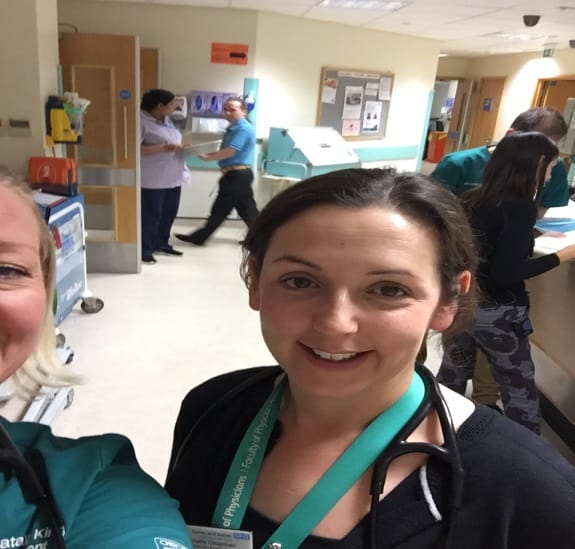
Regulation and updates
Find GMC registration, national guidance and reform updates.
See current requirements →
Learn and get involved
Meet Steffi McLucas and contribute to SAM education, QI and research.
Join the community →The Physician Associate role in Acute Medicine.
Effective contribution depends on well-defined responsibilities, supervision, capability and a supportive medical team—not simply on a job title.
Team-based care
Contribute to continuity, communication and agreed clinical tasks within a supervised team.
Clinical support
Undertake suitable delegated activities, document findings and bring concerns or decisions requiring medical review to the supervisor.
Quality and education
Support audit, patient-safety work, research and multidisciplinary education with appropriate governance.
Professional identity
Introduce yourself accurately as a PA, distinguish the role from that of a doctor and explain who is providing medical oversight.
Clear scope. Effective supervision.
Safe deployment requires unambiguous pathways for medical review, delegation and escalation. The four questions below should be answerable for every PA post.
Which patients and activities?
Document the agreed scope, clinical setting and tasks. The 2025 Leng Review recommends that PAs do not assess undifferentiated patients except under defined national clinical protocols. NHS England issued implementation guidance while further national protocols were developed.
Who provides medical supervision?
Identify the named senior medical supervisor, arrangements for day-to-day medical oversight, available supervision time and accessible escalation. SAM expects consultant oversight for PAs in Acute Medicine.
Who makes clinical decisions?
Specify which findings require in-person medical review and who is responsible for diagnosis, treatment, admission and discharge decisions. PAs must not act as senior medical decision-makers or substitute for required doctor assessments.
Are responsibilities clear to everyone?
Patients should know the professional's role. Supervisors and PAs need explicit arrangements for delegation, documentation, escalating deterioration and audit of safety and outcomes.
Key practice guidance
Read the published national and professional guidance before agreeing a local scope; do not treat draft protocols as an authority to widen practice.
Regulation and the changing PA profession.
Published standards, legislation, national recommendations and consultations do not have the same status. This section separates them clearly.
GMC registration: 13 December 2026
GMC regulation began in December 2024. The statutory transition ends on 13 December 2026.
From that date, individuals must hold GMC registration to work using the protected physician associate title. Employers and PAs should verify registration status and requirements with the GMC.
GMC registration information ↗Current professional boundaries
Prescribing: PAs cannot prescribe while working as PAs, including by relying on previous prescribing rights from another profession.
Ionising radiation: a PA can only act as a referrer where the employer has trained and approved the individual in line with relevant legislation and governance; authorisation is not automatic.
GMC guidance ↗Established guidance
GMC professional standards, supervision advice and relevant employer requirements apply now.
GMC delegation and referral ↗Leng Review (2025)
Recommended clearer identity, named supervision, defined initial roles and restrictions on undifferentiated patient assessment.
Read the review ↗Work in progress
Role-title legislation, clinical protocols and career frameworks are subject to separate implementation and consultation processes. Verify the latest position before changing local policy.
Implementation overview ↗Draft page guidance reviewed: 1 November 2026. National publications and local policy should be checked again before implementation.
Physician Associates across the four nations.
GMC regulation is UK-wide; workforce policy, training support and implementation of role changes may differ. The links below are starting points, not interchangeable national scope-of-practice documents.
England NHS England · RCP · Leng implementation
England is implementing the Leng Review's accepted recommendations, including clearer deployment, supervision and national clinical protocols. The RCP's published interim guidance remains an important specialty-specific reference, read alongside subsequent NHS England instructions.
Northern Ireland Department of Health · HSC employers · GMC
GMC standards apply throughout the UK. Northern Ireland has its own health-service governance and review of PA deployment; practitioners should check current Department of Health and employing HSC Trust instructions rather than assume that all English implementation arrangements apply.
Scotland NHS Scotland Careers · NHS Education for Scotland
Scottish career and education resources describe PA training and employment, while local NHS Board governance determines role arrangements subject to applicable professional and national requirements.
Check pages for their review dates, as older references to the former voluntary register may be outdated.
Wales Health Education and Improvement Wales
HEIW provides PA role, education and development information. Welsh Government accepted the Leng Review recommendations in principle and established an advisory approach to evaluate implementation for Wales.
Learn, improve and contribute.
Use established SAM educational and improvement resources while practising within your agreed role, supervision and governance arrangements.
Learning Hub
Multidisciplinary webinars, podcasts and acute medical learning.
Explore learning → 02FAMUS Hub
Focused ultrasound education, eligibility and supervised training requirements.
Check FAMUS guidance → 03Quality Improvement
Design changes, measure outcomes and share learning safely.
Explore the QI Hub → 04Research Hub
Research collaboration, priorities and opportunities to contribute.
Explore research →Your community. Your voice. Your SAM.
Connect with colleagues, share professional experiences and contribute to education, research and quality improvement across the acute medical team.

Meet your SAM Physician Associate Representative
Steffi McLucas
Physician Associate in Acute Internal Medicine
Mid Cheshire Hospitals NHS Foundation Trust
Steffi has worked in Acute Internal Medicine since qualifying in 2021. Her experience includes acute medical services such as SDEC, AMU and follow-up pathways.
She has contributed to multiple SAMBA initiatives and has a particular interest in education, continuing professional development and improving the experience of colleagues working within Acute Medicine.
As SAM's Physician Associate Representative, Steffi provides a route for PA experiences, concerns and professional-development priorities to contribute to the Society's multidisciplinary discussions.
Learning and connecting
Share experience, learn from colleagues and contribute to multidisciplinary education within Acute Medicine.
SAM provides access to clinical education, professional discussions and opportunities to contribute to teaching and development, within agreed professional roles and supervision arrangements.
Explore the SAM Learning Hub →
Share what works
Have you contributed to an audit, research project, educational initiative or multidisciplinary improvement programme?
Share practical lessons on safe teamwork, clinical communication, role clarity, patient experience and service improvement.
Explore the SAM Improvement Exchange →Get involved with the SAM PA community
Share your feedback
Raise professional concerns, identify support needs or suggest improvements to the PA resources available.
Contact SAM →Contribute to education
Suggest educational topics, case-based discussions or professional-development resources for the wider team.
Visit the Learning Hub →Celebrate improvement
Share projects, publications, audits or multidisciplinary initiatives that have made a positive difference.
Share an improvement project →Guidance content drafted and reviewed 1 November 2026. Review when national protocols, implementation guidance or legislation change.