Research & Publications in Acute Medicine Nursing
Building the evidence base for Acute Medicine nursing — from workforce and education to patient flow, clinical practice and service improvement.
Explore the research that has helped shape the specialty, the evidence behind the Career & Capability Framework, and opportunities to contribute to the next chapter.
Explore publicationsBuilding the evidence base
From understanding the Acute Medicine nursing workforce, to defining educational needs, career progression and a national Career & Capability Framework.
Why nursing research matters in Acute Medicine
Acute Medicine is shaped by nurses every day. Research helps us understand that practice, test what works and build better services for patients and staff.
The questions are often practical ones: how we organise and develop the workforce, how patients move safely through acute care, how nurses build specialist capability, and how services can be improved in a constantly changing clinical environment.
Building an evidence base around those questions strengthens nursing practice, supports professional development and gives Acute Medicine nursing a stronger voice in how services are designed.
Research is not separate from clinical practice. It is one of the ways we understand it, improve it and shape what comes next.
Where the evidence matters
Workforce
Understanding who works in Acute Medicine, how teams are structured and what helps recruit, develop and retain the nursing workforce.
Patient flow & pathways
Exploring how nursing practice contributes to safe assessment, admission, Same Day Emergency Care, discharge and movement through the acute pathway.
Clinical practice & safety
Testing and evaluating approaches that can improve assessment, communication, quality and care for acutely unwell adults.
Education & careers
Identifying the knowledge, skills and support nurses need to develop specialist expertise and build sustainable careers in Acute Medicine.
From clinical question to better practice
A strong research culture starts with the questions that arise in everyday care and carries them through to evidence that can influence practice, services and professional development.
From evidence to practice
Acute Medicine nursing has been asking important questions about its workforce, education and career development for more than a decade.
The focus has progressively moved from understanding who works in Acute Medical Units and what nurses need to learn, towards how specialist expertise can be recognised, developed and sustained throughout a career.
This growing body of work provides important context for the national Career & Capability Framework launched by SAM in 2026.
This is not one piece of research in isolation. It is a developing story about how Acute Medicine nursing understands its workforce and builds its professional future.
Understanding who works in Acute Medicine
A profile of Nurses working in acute medicine units: What is the future?
Early work explored the Acute Medicine nursing workforce and the importance of creating opportunities for experienced nurses to continue developing their careers.
Defining the learning Acute Medicine nurses need
Where Do AMU Nurses Perceive Their Educational Needs? Results of the 20:10 project
Nurses identified conditions, clinical skills and areas of practice where further education could strengthen confidence and professional development.
Moving from experience to progression
Providing a navigable route for acute medicine nurses to advance their practice: a framework of ascending levels of practice
This work explored how progression in Acute Medicine nursing could be described more clearly, including potential transition points and ascending levels of practice.
Understanding what helps — and what gets in the way
Rapid Review of barriers and facilitators to developing knowledge and skills within Acute Medicine to support career progression
The review focused on factors that support or hinder nurses and allied professionals in developing Acute Medicine knowledge, skills and careers.
A national Career & Capability Framework for Acute Medicine nursing
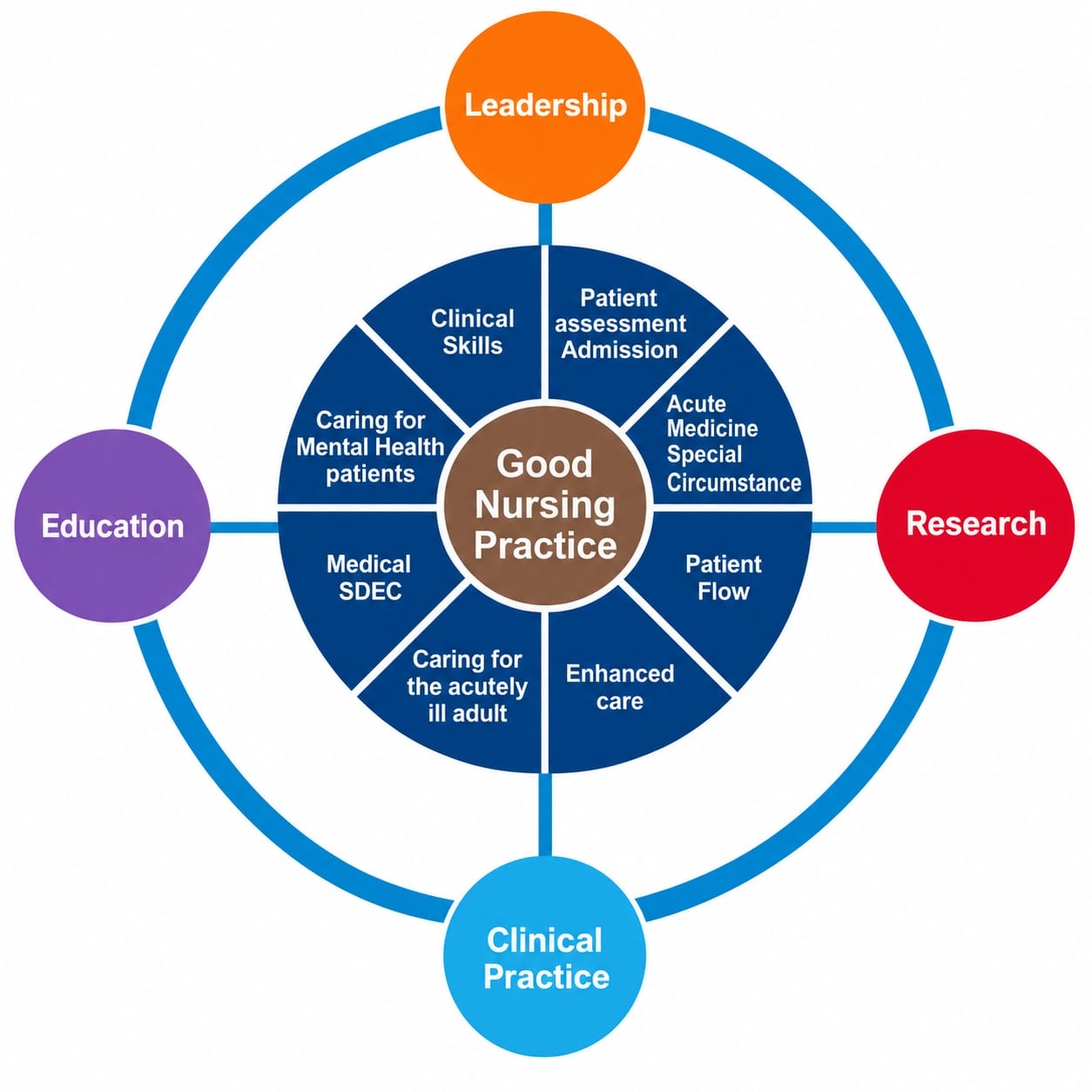
Acute Medicine Career & Capability Framework for Nurses
In July 2026, SAM launched a national framework providing a clearer pathway from being new to Acute Medicine through to advanced practice, while recognising the specialist knowledge and capability that nurses develop throughout their careers.
Good nursing practice sits at its centre. Around it are the capabilities required within Acute Medicine and four interconnected pillars through which nurses can develop professionally.
As Acute Medicine nurses develop, opportunities to engage with evidence, evaluation, quality improvement and research should sit alongside clinical practice, leadership and education.
Help shape Phase 1
Your voice matters. Join the Acute Medical Nursing Leadership Network on WhatsApp and take part in the evaluation helping SAM understand how the framework works in practice and how it should develop for Acute Medicine nurses.

Scan with your phone camera to join the network
The evidence story continues
The framework is not the end point. Its evaluation, workforce data, clinical research and the experiences of nurses working across Acute Medicine can continue to inform how both the framework and the specialty develop.
Featured nursing research
A selection of recent work showing the breadth of Acute Medicine nursing research — from bedside clinical skills to workforce planning and professional development.
Point of Care Ultrasound Bladder Volume Calculation on the Acute Medical Unit
Nursing staff, healthcare assistants and other professionals on an AMU were taught to use portable point-of-care ultrasound for visualisation and calculation of bladder volume.
A short teaching intervention increased practitioners' confidence in using the semi-automated visual method, demonstrating how an additional bedside skill can be introduced to the Acute Medicine workforce with relatively little training.
Nunan J, Lister T, Howgill H, Parreno MMM, Brown G & Walden A · Acute Medicine · 23(1):37–42
Read the publicationBarriers and facilitators to developing knowledge and skills within Acute Medicine
This rapid review examined what helps and hinders nurses and allied professionals in acquiring the knowledge and skills needed for career progression in Acute Medicine. It formed the first stage of work to develop an updated career framework.
Lees-Deutsch L, Kendrick A, Bailey N, Burnett E, Kelly T & Laugher H · Coventry University
Read the reportNurse staffing levels within acute care: results of a national day of care survey
Using SAMBA data from 122 acute hospitals, this study examined AMU nurse staffing and compared available nursing time with the estimated time required to deliver direct clinical care.
Hegarty H, Knight T, Atkin C, Kelly T et al. · BMC Health Services Research
Read the publicationNurse SAMBA
National data helps make the Acute Medicine nursing workforce visible — giving us a clearer picture of who is delivering care, how services are staffed and where the profession may need to develop.
Building a national picture of Acute Medicine nursing
Since 2019, SAMBA has included questions on the nursing workforce, helping to build a national picture of what is happening across Acute Medicine services. Nurse SAMBA helps ensure nursing is part of the evidence used to understand the specialty.
Want to get involved in Nurse SAMBA?
If you are interested in contributing to nursing workforce data collection, have a question about Nurse SAMBA or want to help develop how nursing is represented within future SAMBA work, please get in touch with the SAM Nursing Representative.
Contact the SAM Nursing Representative
For Nurse SAMBA enquiries, participation or ideas about future nursing workforce data:
Better visibility supports a stronger profession
Understanding the nursing workforce is part of understanding Acute Medicine itself. National data can help identify variation, inform future questions and strengthen the evidence behind workforce and service development.
Nursing publications
Explore the published work that has contributed to our understanding of Acute Medicine nursing — spanning workforce, education, patient flow, safety and clinical practice.
Showing 11 publications
Point of Care Ultrasound Bladder Volume Calculation on the Acute Medical Unit
Acute Medicine
Report on the barriers and facilitators for nurses and therapists allied to health, in developing their knowledge and skills within acute medicine, to support career progression: A Rapid Review
Coventry University
Nurse staffing levels within acute care: results of a national day of care survey
BMC Health Services Research
Patient and Caregiver Experience of Hospital Discharge from an Acute Medicine Unit via the Discharge Lounge: A Qualitative Case Study
Acute Medicine
Changing the nursing handover
British Journal of Nursing
Providing a navigable route for acute medicine nurses to advance their practice: a framework of ascending levels of practice
Acute Medicine
Developing and Evaluating Nurse led Discharge in Acute Medicine
Acute Medicine
A national survey exploring the profile of registered nursing staff working in AMUs
Research report
Where Do AMU Nurses Perceive Their Educational Needs?
Acute Medicine · Results of the 20:10 project
Improving the safety of patient transfer from AMU using a written checklist
Acute Medicine
A profile of Nurses working in acute medicine units: What is the future?
Acute Medicine
Get involved in nursing research
You do not need to begin with a research title, funding application or academic post. Research often starts with noticing something in practice and asking whether we understand it well enough.
A question from practice can be the beginning
Acute Medicine nurses are ideally placed to identify important questions about patients, workforce, education and how services operate. You can contribute whether you are taking your first step into research or already developing and leading projects.
Research is part of professional practice
Getting involved might mean helping collect data, joining a study team, evaluating a service change, developing a research question, presenting work at SAM or building towards your own academic pathway. There is no single route into research.
The evidence base for Acute Medicine nursing grows when nurses ask questions about the care they deliver. Your question could be where the next piece of evidence begins.