Build your confidence to improve care
Quality improvement is a skill that can be learned, practised and developed. Whether you're exploring QI for the first time, teaching colleagues or preparing to lead improvement, SAM can help you build the knowledge to make a difference in acute medicine.
Understand the essential principles, learn how to measure and test changes, and discover practical activities for the whole multidisciplinary team.

Choose how to learn
From understanding the fundamentals to teaching colleagues and developing your professional practice, explore the learning opportunities that best suit you and your team.
Getting started
Explore the fundamentals of quality improvement through clear explanations, acute medicine examples and short questions to check your understanding.
Start learningTeaching resources
Use SAM's original Quick Guide and Comprehensive Workbook, including our online document reader, to support individual learning and team teaching.
Explore the guidesBuild a Robot
Experience QI through a practical team challenge. Use guided videos, timed tests, PDSA cycles and a live run chart to learn by doing.
Start the activityMDT learning
Quality improvement works best when the whole team contributes. Explore meaningful involvement, shared responsibility and multidisciplinary approaches to improving acute medical care.
Explore MDT workingProfessional development
Find QI guidance relevant to your professional pathway, including national frameworks, appraisal, revalidation, curriculum expectations and evidence of your contribution.
Find guidance for your professionUnderstand the essentials
Explore the ideas behind quality improvement, see how they apply to acute medicine and check your understanding with short practical questions.
Understanding quality improvement
Quality improvement is a systematic way of understanding and improving how care is delivered. It uses evidence, measurement and iterative tests of change to help make care better.
An AMU team wants more reliable medicines reconciliation. Rather than simply sending a reminder, it examines why the current process is inconsistent.
Check your understanding
Does every QI project need to introduce a completely new clinical intervention?
These questions are for learning and reflection. Answers and scores are not stored.
Common questions about QI
A few distinctions are worth understanding before undertaking your first project.
What is the difference between QI, clinical audit and research?
Clinical audit usually compares care against an agreed standard. Quality improvement focuses on systematically changing a process and learning whether care improves. Research aims to generate new knowledge using an appropriate study design. The methods can overlap, so the project label alone does not decide governance or ethics requirements. Check with your local governance or research teams.
Do I need to lead a large project?
No. A meaningful contribution to a multidisciplinary improvement project can be valuable. Small, well-designed tests may offer more useful learning than a large intervention introduced without sufficient understanding or measurement. Professional evidence requirements depend on your role and training or regulatory framework.
What if a change doesn't work?
A test that doesn't produce the predicted improvement can still be valuable if the team learns from it. Record what happened, examine the reasons and decide whether to adapt, adopt or abandon the change. Report limitations and unexpected effects.
How do we know an improvement has been sustained?
Continue measuring the relevant outcomes and processes after implementation. Look at data over time, consider changes in staffing and case mix, and establish who owns the process and responds if performance deteriorates.
Where should I keep project data?
Use systems approved by your organisation and follow local information-governance requirements. Avoid entering identifiable patient information into public QI tools, teaching exercises or external websites that have not been approved for that purpose.
SMART aim
A specific, measurable and time-bound statement of the change a team wants to achieve.
PDSA
Plan–Do–Study–Act: a structured cycle for predicting, testing, studying and adapting change.
Process measure
A measure of whether an intended process is happening as expected.
Balancing measure
A measure used to identify unintended consequences elsewhere in the system.
Practical learning toolkit
Two original SAM publications support the Five Steps to Better Care. Start with the eight-page Quick Guide, then explore the Comprehensive Workbook for more detailed methods and examples.
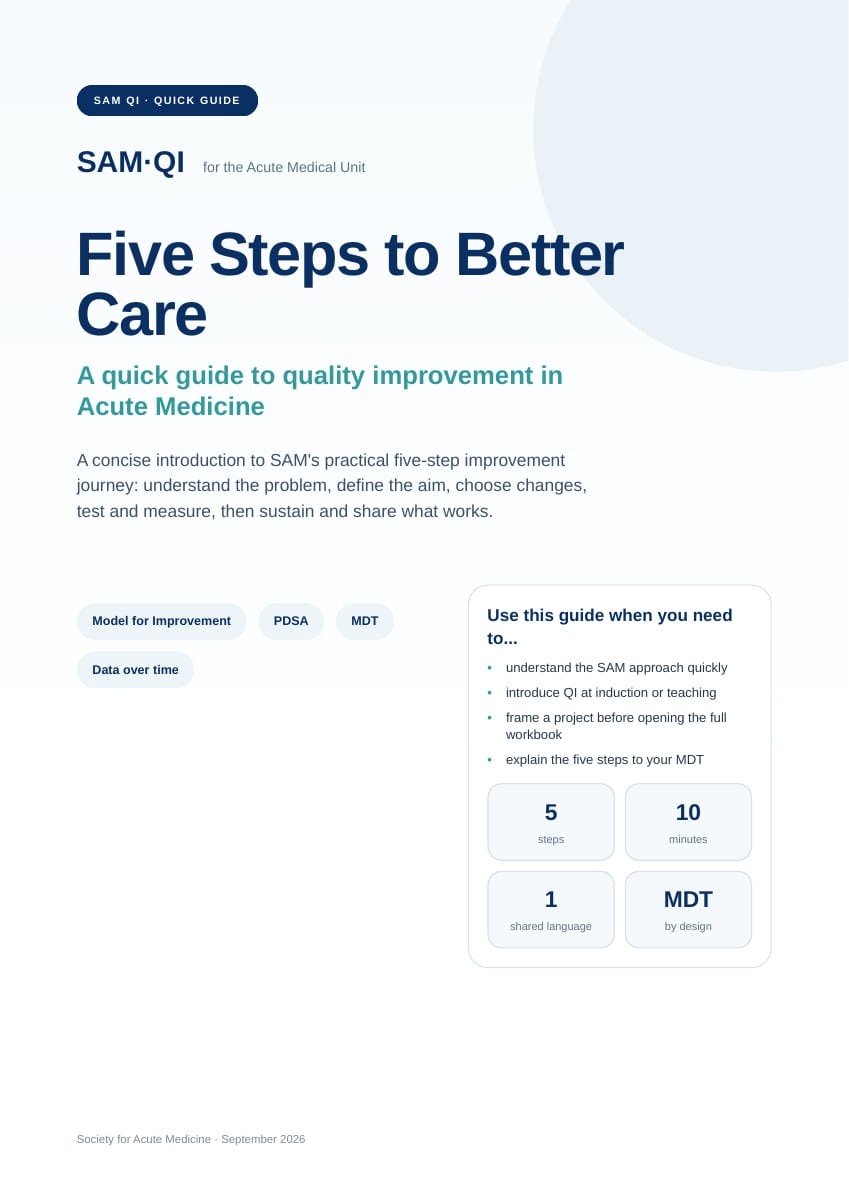
Five Steps Quick Guide
A concise introduction to understanding a problem, defining an improvement aim, choosing changes, testing and measuring improvement, and sustaining what works.
Ideal for getting started, induction and short multidisciplinary teaching.
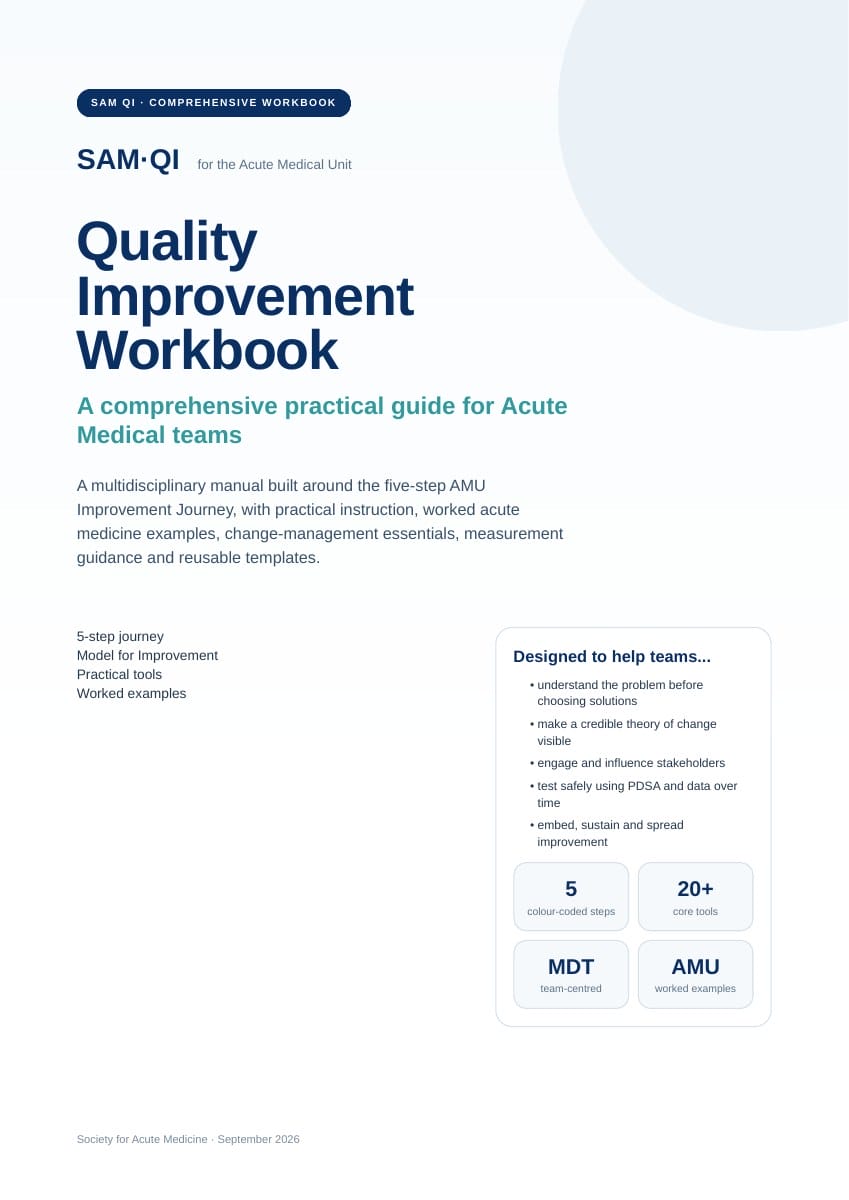
Comprehensive QI Workbook
Detailed practical methods, worked acute medicine examples, change-management guidance, measurement approaches and reusable project templates.
Ideal when you're ready for more depth or are undertaking a project.
Read the guides online without changing the original documents
SAM's online reader preserves the original PDF layouts and printed page numbers. You can navigate pages, use document contents, search and change the zoom level.
- Navigate between pages in your browser.
- Use contents and bookmarks where available.
- Search within the selected PDF.
- Open the original document whenever needed.
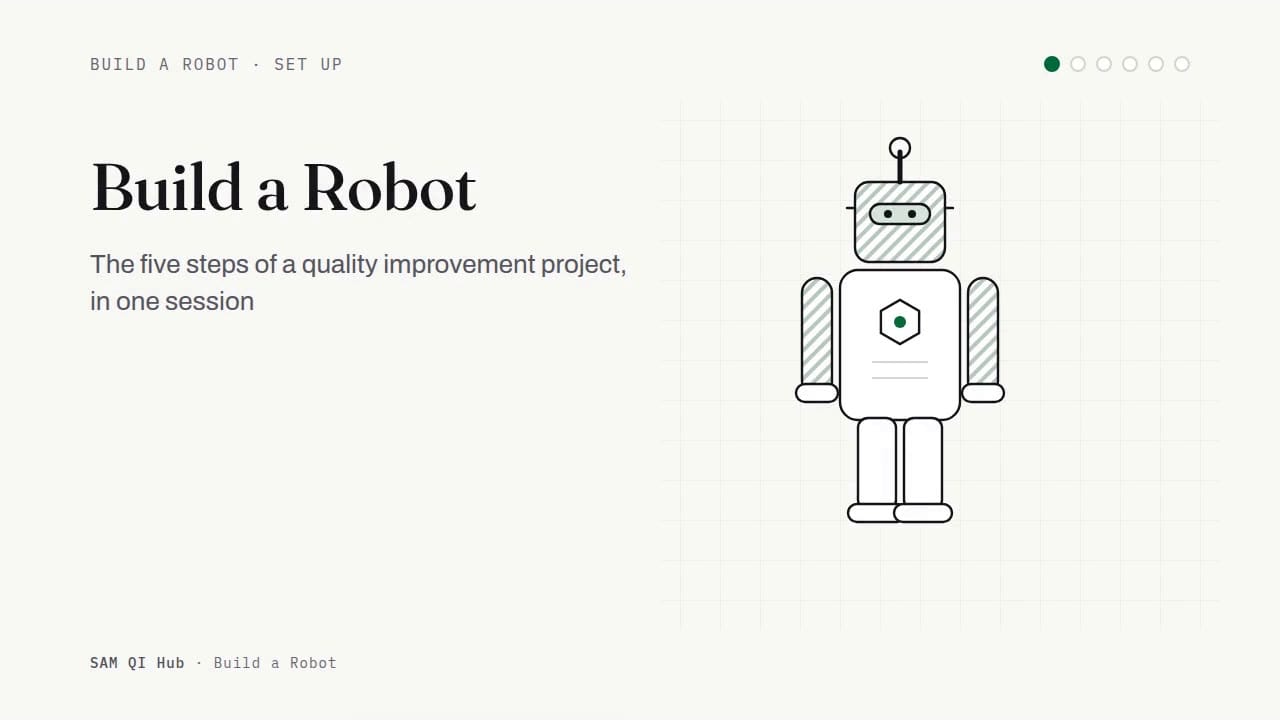
Learn by doing. Teach by doing.
Build a Robot turns improvement theory into a practical team challenge. Participants build paper robots, measure time and defects, test changes and discover why sustainable improvement needs teamwork and reliable processes.
Use it for induction, departmental education or a multidisciplinary teaching session. The dedicated interactive page includes the printable pack, videos, timer, measurement recording and run chart.
A simple approach for facilitators
Before the session
Print and prepare the robot kit, organise teams and agree who will facilitate timing and inspection. Review the videos and exercise rules.
During the activity
Allow teams to experience baseline performance before making changes. Encourage clear predictions, small tests and honest recording of results.
After the exercise
Discuss variation, defects, teamwork and whether another team could reproduce the result. Connect the lessons to a real clinical pathway or service problem.
Improvement is a team skill
Better care is rarely achieved by one profession working alone. Learn to bring different perspectives together, develop your skills and make improvement part of everyday clinical practice.
Learn with the people who deliver and experience care
Acute medical pathways depend on nurses, doctors, advanced practitioners, pharmacy, allied health professionals, support workers, operational colleagues and many others.
Patients and carers can identify difficulties that services may not recognise themselves. Meaningful improvement includes people who understand the pathway and the experience of receiving care.
Bring knowledge of assessment, treatment, safety, handover and day-to-day care.
Explain what matters, where care falls short and whether changes are improving their experience.
Help understand pathways, capacity, information systems, data quality and implementation.
Support improvement crossing professional, service or organisational boundaries.
Ready to put your learning into practice?
Start with a problem that matters, work with the people affected, choose meaningful measures and test changes on a manageable scale. Follow SAM's Do QI pathway to turn an improvement idea into practical learning and better care.