Long wait death figures “a source of national shame” – SAM president (08 June)
Please find below statement from the Society for Acute Medicine relating to Royal College of Emergency Medicine analysis which shows the estimated number of deaths linked to long waits in Emergency Departments across England has surged almost tenfold over the past decade.
Dr Vicky Price, president of the Society for Acute Medicine, said: “These figures are a source of national shame.
“For years we have known that prolonged waits in overcrowded emergency departments are associated with avoidable harm and excess deaths. The evidence is not new, the warnings are not new, yet the scale of the problem continues to grow.
“What is particularly concerning is that the debate has increasingly focused on where patients are waiting rather than why they are waiting. Nobody wants to see patients cared for in corridors, but simply moving people into waiting rooms, temporary escalation areas or other unsuitable spaces does not address the underlying risk.
“It is overcrowding that harms patients. It is delays to assessment, treatment and admission that harm patients. Those risks do not disappear simply because they are moved out of sight.
“Acute clinicians continue to report extremely frail and vulnerable patients spending prolonged periods in overcrowded environments because there are no staffed beds available elsewhere in the system. These are not isolated incidents. In many hospitals they have become routine.
“There is a growing concern among frontline staff that we are seeing the gamification of performance measures rather than meaningful improvement in patient care. Success cannot be defined by whether a corridor is empty if the same patients are now waiting in another inappropriate area.
“If we are serious about reducing harm, we must focus on the fundamentals: increasing staffed bed capacity, improving discharge pathways, supporting social care and ensuring hospitals have the workforce they need. Until then, patients will continue to face unacceptable delays and staff will continue to work in conditions that fall far short of what they want to provide.”
More from SAM
More news, statements and updates from the Society for Acute Medicine.
-
“13% rise in 12-hour waits should set alarm bells ringing” – SAM president (08 October)
Commenting on the latest NHS performance data released today (08 October) Dr Vicky Price, president of the Society for Acute Medicine, said: “A 13% year-on-year rise in 12-hour emergency department waits as winter approaches should set alarm bells ringing. “More than 50,000 patients waited over 12 hours from the decision to admit to admission in…
-
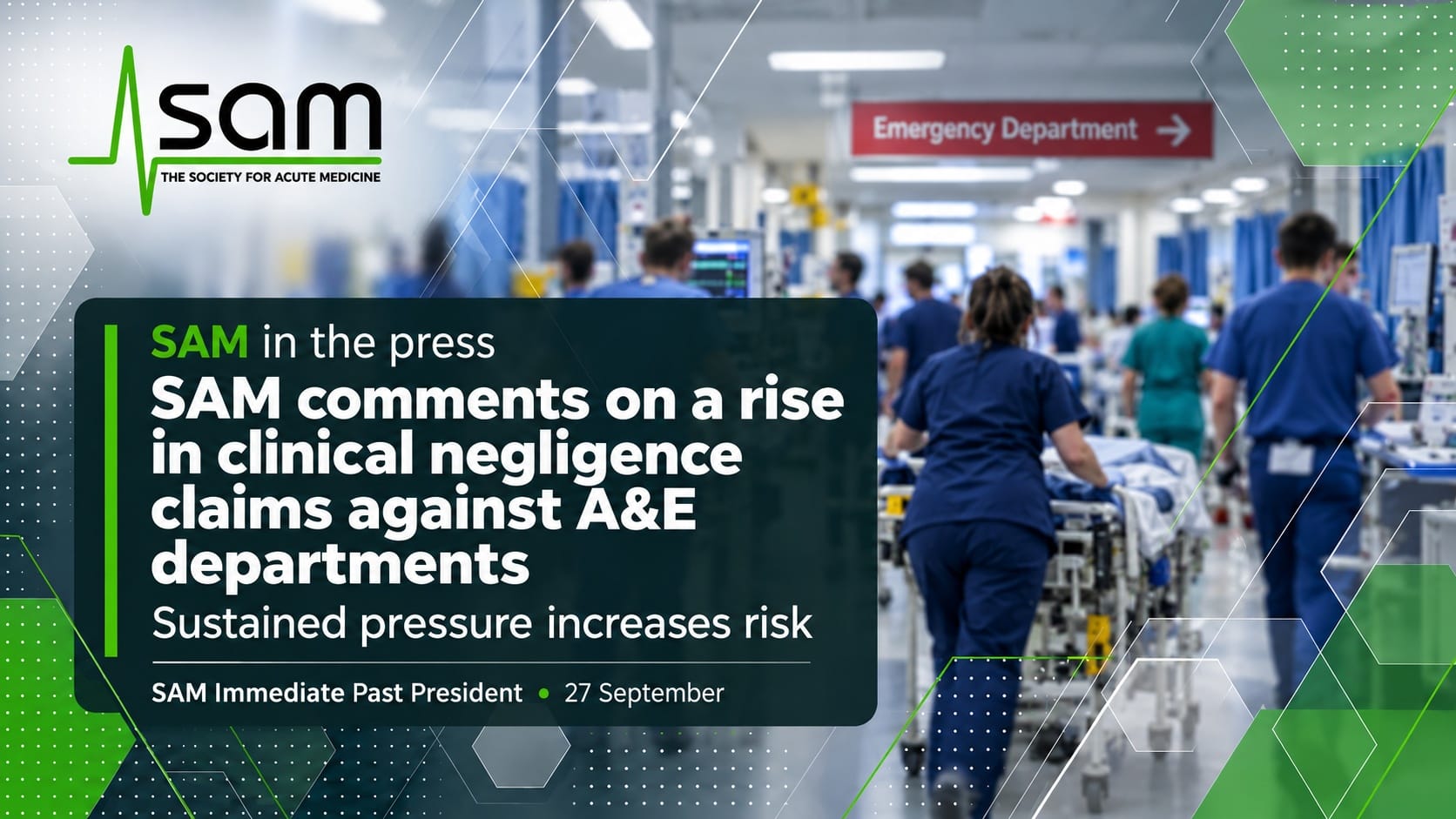
“Sustained pressure increases risk” – SAM immediate past president (27 September)
Commenting in an article in The Sun on a rise in clinical negligence claims against A&E departments, Dr Nick Murch, immediate past president of the Society for Acute Medicine, said: “Rising demand, overcrowding, long waits and staff shortages all create a more difficult environment in which to deliver safe, timely care. “Reduced bed capacity can…


Society for Acute Medicine
Setting the standard. Improving acute care.