Fewer than one in five acutely unwell patients first assessed on specialist acute medical units, warns SAM (10 October)
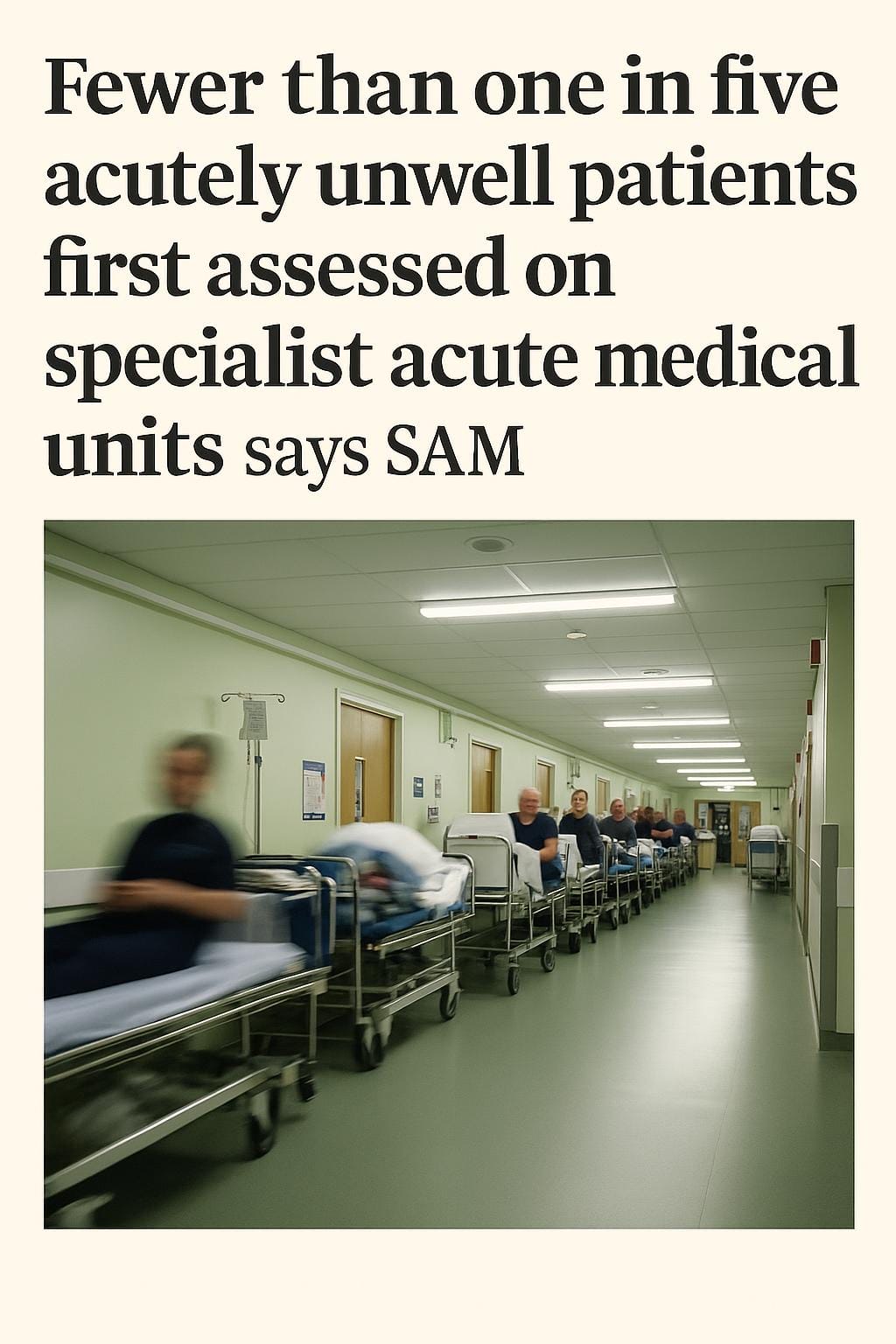
Patients are being left in hospital corridors for dangerously long periods and missing timely access to specialist care, the Society for Acute Medicine (SAM) has warned.
Latest data, presented at the Society’s bi-annual conference in Manchester, showed fewer than one in five acutely unwell medical patients are receiving their first assessment in an acute medical unit (AMU).
Acute medicine deals with the immediate and early treatment of adult patients with a variety of medical conditions who present to hospital as emergencies.
The specialty receives the majority of patients admitted from A&E and helps maintain the flow of patients through emergency departments to avoid exit block.
The latest Society for Acute Medicine Benchmarking Audit (SAMBA) included over 10,000 patients and showed:
– Nearly half were initially seen in emergency departments rather than AMUs.
– Fewer than 10% spent less than four hours waiting in emergency departments.
– More than 50% waited more than 12 hours in emergency departments.
– Older and frailer patients were most likely to wait more than twelve hours before admissions.
New SAM president Dr Vicky Price said: “Corridor care is causing harm for patients on a daily basis. It is associated with increased length of stay and increased mortality and patients should be flowing through AMUs.
“The evidence shows that patients have better outcomes when they come through acute medical units – lower mortality, shorter stays and better patient experience, so we must fix this situation.”
Addressing the conference, SAM past president Dr Tim Cooksley emphasised the scale of the problem. “We have patients in corridors, not just in our emergency departments but in our acute medical units as well, and our occupancy levels are too high,” he explained.
“We still have over 1,000 patients a day in England alone waiting more than 12 hours in emergency departments, and most of those are acute medical patients waiting for a bed on an acute medical unit.
“Many are older, frail and vulnerable to sustaining harm while they are waiting.”
The conference marked SAM’s 25th anniversary and featured more than 50 speakers across two days last week (22 and 23 September).
Keynote contributors included Sir Jim Mackey, NHS England chief executive, who discussed the national urgent and emergency care recovery plan, and Professor Mumtaz Patel, president of the Royal College of Physicians, who spoke about the future of acute medicine.
SAM Fellowships were awarded to Dr Nick Scriven, a past president of SAM and NHS England national specialty adviser, and Dr Chris Subbe, consultant in acute, respiratory and critical care medicine. Professor Chris Whitty, chief medical officer for England, received an Honorary SAM Fellowship, describing it as “a great honour”.
Following Dr Price’s appointment as SAM president, Dr Nick Murch now takes up the position of immediate past president, succeeding Dr Cooksley, and Dr Ragit Varia steps into the role of president-elect of SAM.
Closing the conference, Dr Price added: “Acute medicine was created to improve care for the sickest patients and evidence showed it did that really well. We must use our expertise to change the system and get flow back through acute medical units – because patients cannot afford to wait.”
More from SAM
More news, statements and updates from the Society for Acute Medicine.
-
1,450 patients a day experienced delays of over 12 hours last month – SAM statement (10 September)
Commenting on the release today of the latest NHS performance data, Dr Vicky Price, president of the Society for Acute Medicine, said: “Today’s figures show that 44,951 patients waited more than 12 hours in emergency departments from decision to admit to admission in August, up 25.2% on last year. That means 1,450 patients a day…
-
‘NAO’s findings end suggestion marginal A&E improvements are enough’ – SAM president (9 September)
Commenting on the National Audit Office report into NHS A&E performance published today (9 September), Dr Vicky Price, president of the Society for Acute Medicine, said: “The NAO’s findings should end any suggestion that marginal improvements are enough. Patients are still waiting far too long, and progress remains too slow. “The result is greater overcrowding,…



Society for Acute Medicine
Setting the standard. Improving acute care.